
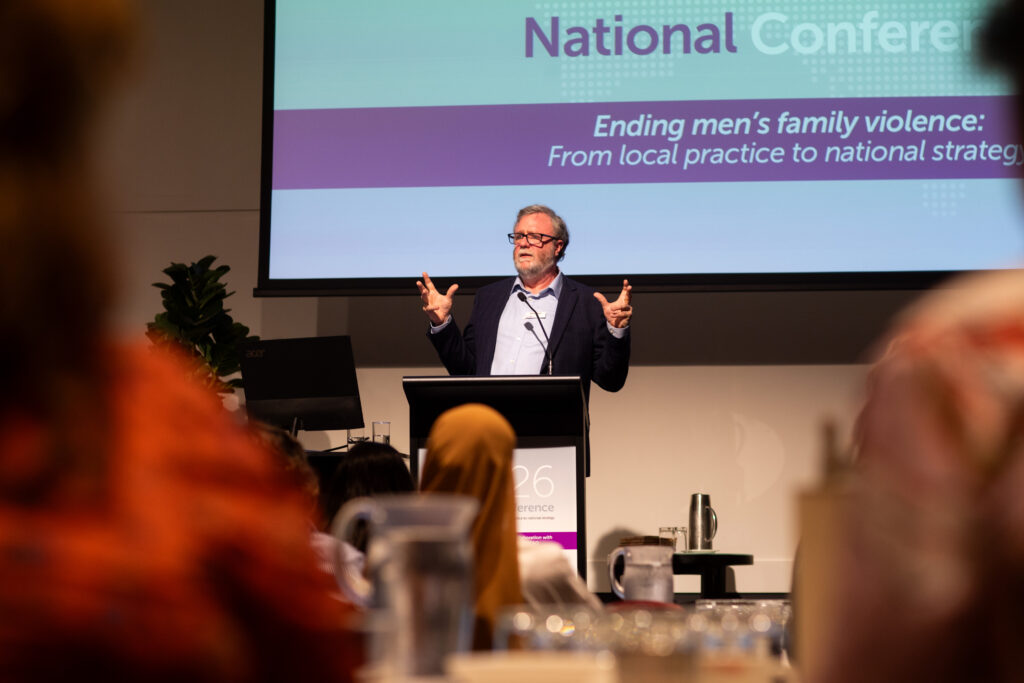
Wow! Back in Melbourne after an incredible couple of days in lutruwita/Tasmania for the 2026 National Conference on Ending Men’s Family Violence: From Local Practice to National Strategy, a collaboration between Stopping Family Violence, SPEAQ and No to Violence.
Proud Pakana Elder, Delia Summers, welcomed 382 delegates in-person and online to beautiful palawa country. Delia spoke of her own experience and reminded us that “stopping family violence is everyone’s responsibility” and urged us to “refuse to be silenced by fear” – a message that resonated and became even more profound over the following two days.
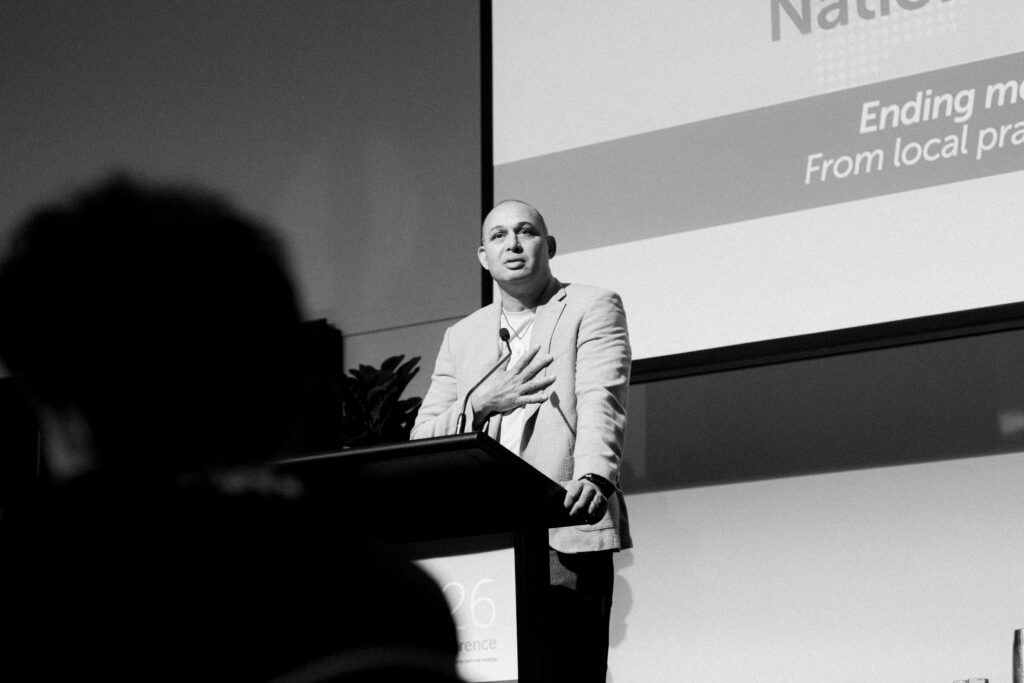
The incredible Thomas Mayo set the scene for the conference in his opening keynote. A powerful and personal reflection and insights on men, masculinities and fatherhood alongside the struggle for justice and social change from the pearl lugger maritime strikes in the 1930’s to the Uluru Statement from the Heart. Thomas’s insights and work in the union movement formed a compelling call to solidarity and action: to mobilise people power, take organisational action, demand good government policy with consistency, relentless determination and courage.
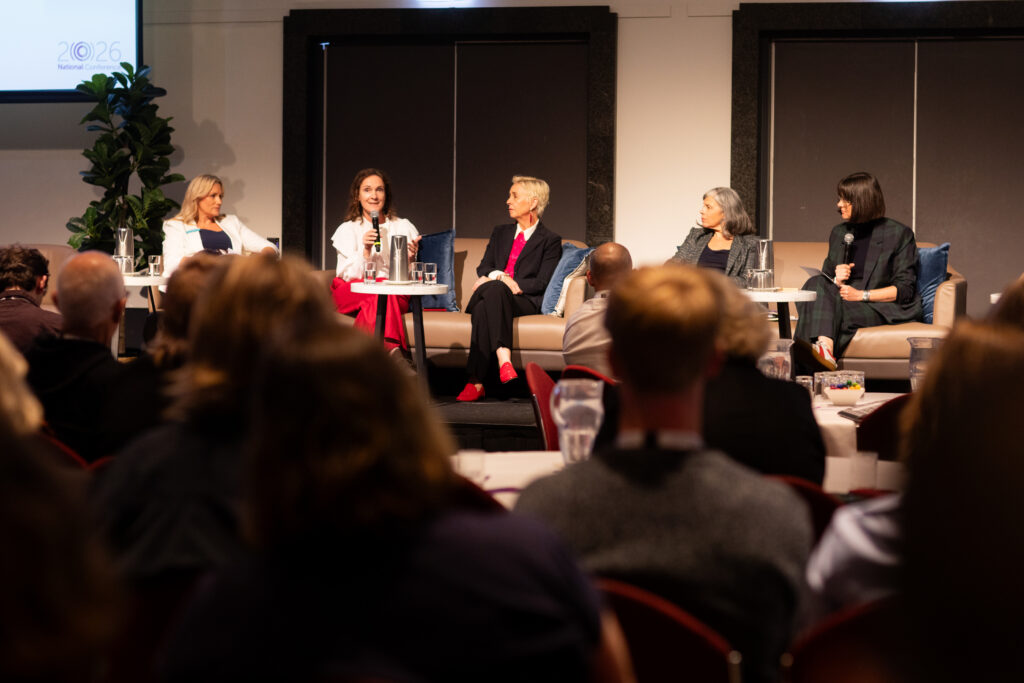
Thomas then joined the opening panel session which reflected on lessons we’ve learned as a sector and lessons we have failed to learn. Kate Jeffries from Stopping Family Violence emphasised the need to recognise and amplify the skills of the workforce and Tessa Boyd-Caine, CEO of the Australian National Research Organisation for Women’s Safety (ANROWS), committed to continuing to share learning from research and evaluations while the national Domestic, Family and Sexual Violence Commissioner Micaela Cronin focused on the need for “fundamental work to transform systems.” Karen Bevan urged us to “never assume that men’s violence is inevitable” and facilitator Kristine Ziwica provided a sobering reminder that “only half of the National Plan outcome measures have any data.” We must do better.
Coinciding with the international release of Louis Theroux’s documentary Inside the Manosphere, the conference devoted significant attention to key debates surrounding masculinities. This conversation was foregrounded through an insightful panel, including Professor Donna Chung (Curtin University), trans advocate Charlie Burton and Dr Shawna Marks (No to Violence) exploring how masculinities are being reconceptualised and the implications of this for marginalised men.
ANROWS then launched ‘An Introductory Guide to the Manosphere and the Impacts for Young People, Teachers and Schools’, which generated significant media coverage, thanks to leading research from Stephanie Wescott from Monash University and insights from Ben Vasiliou from The Man Cave and Matt Tyler from Jesuit Social Services. Read more here.
Attention then turned to the role of Corporate Australia in ending men’s violence, including workplace policy, culture and closing system gaps that can be misused to facilitate abuse. The panel included Caitlin Davies (NTV’s Head of Workforce and Sector Development) joined by Ciara Sterling (Thriving Communities), Debra Filipin (DIA Partners), Cameron Geason (Origin Energy) and James Stafford (National Australia Bank). Their crucial discussion highlighted that family violence does not sit outside our institutions. It intersects with the systems people rely on every day – workplaces, financial services, technology platforms and legal systems.
Panellists explored how these systems can unintentionally enable coercion, financial abuse and control, or be designed to interrupt harm and strengthen safety. The conversation challenged corporate Australia to move beyond statements of support and take structural action through governance, workplace culture and partnerships with the specialist family violence sector. The message was clear: institutions with the reach and influence of corporate Australia have both the power and responsibility to help disrupt the conditions that allow violence against women to persist.
Day 1 concluded with insights from Jacquie O’Brien of Respect Victoria and Cameron McDonald of Our Watch, who prompted discussion on shifting social norms and mobilising communities for prevention.
Delegates then gathered for a lively networking event on Hobart’s waterfront, continuing conversations and connections from the day.
Day 2 opened with impact.
Courage, resilience and determination are powerfully embodied by Grace Tame. Despite a campaign to deplatform the former Australian of the Year, conference organisers refused to silence one of the country’s most important voices for change. Grace’s story captivated the room, with delegates rising to their feet in a standing ovation in solidarity with her and with victim-survivors around the world.
Grace spoke candidly about the personal cost of speaking truth to power and the growing pressure faced by survivors who step into public advocacy. She revealed that several organisations had withdrawn speaking engagements amid a coordinated campaign against her, describing the impact of losing most of her speaking bookings for the year.
Her keynote reinforced a critical lesson for the sector: that survivor voices are often celebrated in principle but can be quickly abandoned when they challenge institutions or provoke controversy.
No to Violence CEO Phillip Ripper later told media there had been organised efforts to pressure conference organisers to remove Grace from the program. Instead, the organisation made a deliberate decision to stand firm. He also called on organisations that claim to centre the voices of victim-survivors to continue supporting them, even when that support becomes uncomfortable or politically difficult.
After taking a moment to pause and reflect, delegates refocused on the leading work of the Pathways Project. Enabled by the visionary support of the Snow Foundation, the project has engaged with over 150 practitioners across Australia to map out what an expanded and integrated ecosystem of responses to men’s violence needs to look like. As the political and policy interest grows and the range of interventions emerging across the continent, Pathways Project Lead Max Castle, sector leader Rodney Vlais, proud Wirangu, Kokatha, Mirning woman and Relationships Australia South Australia MBCP practitioner, Sareena Saunders and Biljana Milosevic, CEO of Jannawi Family Centre, shared initial insights from the project’s findings. While practitioners deeply value the need to grow the range of services available, they are concerned that this growth needs to be safe. A key output of the report is a guiding framework to ensure safeguards for meaningful violence cessation. This was followed by a powerful presentation from Uncle Charlie Rowe from the Aboriginal Family Legal Service Queensland, who has been involved in the Pathways Project, sharing practice and community leadership lessons from working with Aboriginal men in the Bambra Mari program in Toowoomba.
The conference also showcased the leading work on holding systems to account. This included Tasmania’s own – Engender Equality’s Alina Thomas and Sneha Sapkota with Bree Klerck from the Tasmanian Family and Sexual Violence Alliance. Engender Equality gave the audience an in-depth look behind the curtains at their landmark report on systems abuse in Tasmania. This was followed by a powerful session on what transformational change is needed with Lucy Mercer-Mapstone (Laurel House/Collective Voices), Shaymaa Elkadi (Ruqi Consulting) and Sareena Saunders joined Shawna Marks to answer burning questions from conference attendees on how to make change at individual, leadership and systemic levels. The audience was treated to a rare in-depth look at how change is made and the chance to ask gnarly questions on areas they see holding back change.
A strong theme throughout the conference was the need to centre the experiences of children and young people as victim-survivors in their own right. The Children and Young People stream on the afternoon of day two featured presentations from Dr Carmel Hobbs (University of Tasmania), who reflected on the distinct dynamics of youth intimate partner violence – including how developmental stage, peer relationships, and limited resources shape young people’s experiences – and Toby Stoddart and Peter Buckler from Home Base, who spoke about their programs with young people using violence, emphasising the importance of whole-of-family approaches and relational connection in driving change.
Professor Kate Fitz-Gibbon (Monash University) and Matt Tyler (Jesuit Social Services) followed, presenting on effective supports and interventions for children and young people experiencing and using violence. Drawing on the Adolescent Man Box Study and qualitative research with over 100 child victim-survivors across Australia, Fitz-Gibbon and Tyler highlighted the scale of the challenge (one in four young people experiencing between three and five different forms of abuse and violence) and the unique developmental needs, relationship dynamics, and service gaps that distinguish children’s experiences from those of adults. They emphasised that siloed policy responses fail to reflect the overlapping realities that children actually live in, and that supporting young victim-survivors to recover and heal is itself a form of prevention.
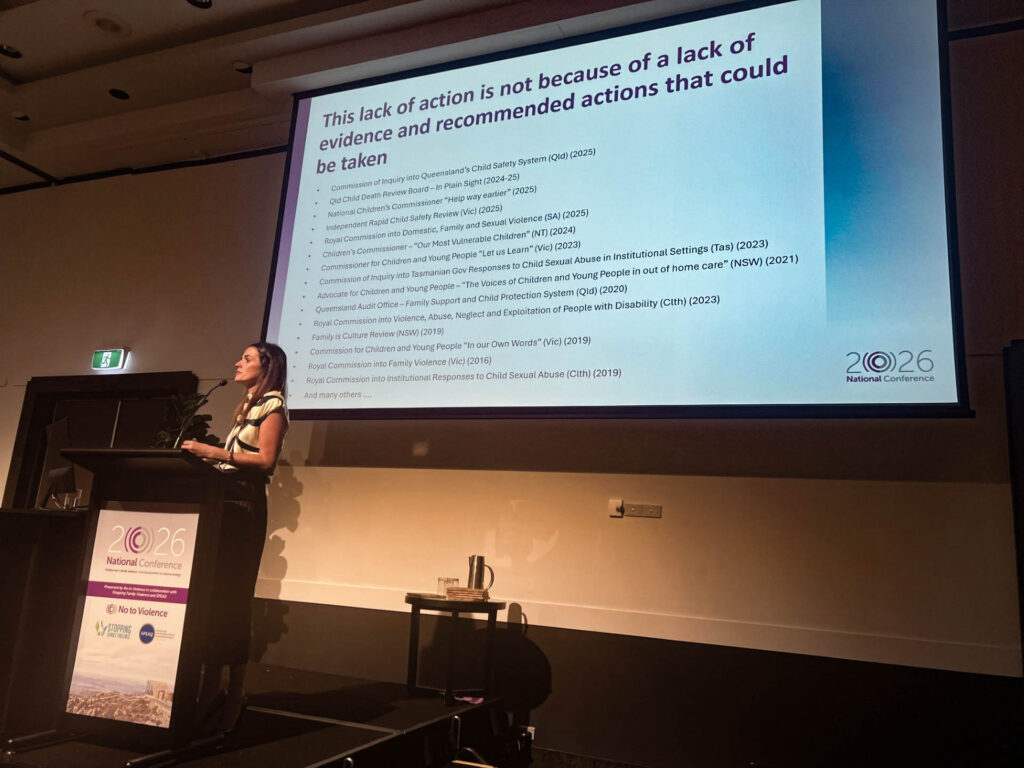
This was followed by a panel of victim-survivor advocates (Ruben, Esra, and Conor Pall) facilitated by Conor, who shared deeply moving insights into their experiences at the hands of services and responders, including police, as children and young people experiencing violence. Their testimony brought into sharp relief what it truly means to centre young people’s experiences, and how far.
There was also a central focus on best-practice and addressing workforce issues. This included a session from Silke Meyer from Griffith University on the role that practitioners can play in recognising and responding to men’s use of coercive control post-separation. Looking at key cross-sectoral work, Mark O’Hare from Stopping Family Violence and James Hunter from Cyrenian House Alcohol and Other Drug (AOD) Service explored collaboration with the AOD sector. There was also a key conversation on the need to continue building and supporting the specialist men’s family violence workforce was ever present and discussed with Michelle Royes (SPEAQ), Kate Jeffries and Nadia Jacobsen NTV’s National Practice Lead, finishing up with Dr Ron Frey (University of Tasmania) and Tracey Groombridge (Lifeline Tasmania) concluding the penultimate conference session with a focus on hope.
Over the course of the two-day conference, victim-survivors, advocates, practitioners, researchers and policymakers shared what they believe needs to be done to end men’s use of family violence. To bring these insights and key areas of consensus together, a team of conference rapporteurs, including Sareena Saunders, Shaymaa Elkadi, Sneha Sapkota, Conor Pall, Mark O’Hare, and Alex from SPEAQ, along with Rebecca Buys and Phillip Ripper, worked to develop a Conference Declaration.
The rapporteurs attended all conference sessions, engaged with delegates, reviewed feedback from online participants and in-person contributions to the ‘conversation wall’ to craft a conference declaration articulating our collective commitment to solidarity and collective action. The final declaration was put to the conference by Mark O’Hare, seconded by Alex (SPEAQ) and endorsed unanimously by conference delegates.
We hope this statement will be a central part of building an advocacy coalition to shape whole-of-government and whole-of-community responses to ending men’s use of violence. You can read the declaration here:
NTV | National Conference Declaration: Thursday 12 March 2026
In closing, we had the opportunity to present the Conference Declaration to Hon Amanda Camm (Queensland’s Minister for Child Safety and the Prevention of Domestic and Family Violence, whose state of Queensland became the first jurisdiction in the nation to develop a dedicated strategy focussed on stopping family violence at the source Broadening the focus: Queensland’s strategy to strengthen responses to people who use domestic and family violence 2024–28 and the Hon Jodie Harrison, NSW Minister for Women and for the Prevention of Domestic Violence and Sexual Assault, who has driven her state’s first whole of government strategy addressing the perpetration of family violence Building Better Responses: NSW Strategy to Respond to the Use of Domestic and Family Violence 2026–2030. The two ministers were joined by Micaela Cronin to share their reflections on the Conference Declaration. The Commissioner urged the sector to contribute to the soon-to-be started consultations for the Second action plan under the National Plan to End Violence against Women and Children.
We again wish to thank our generous sponsors and supporters including, the NSW government which enabled all NSW Men’s Behaviour Change Network members and their organisation to join the conference online, as well as supporting the in-person attendance of a number of delegates from marginalised and under-represented NSW communities and organisations.
We would also like to thank the Tasmanian government – particularly Business Events Tasmania – Anglicare Victoria, White Ribbon Australia, KWY Aboriginal Corporation, Better Steps Learning, Engender Equality and Wesnet, along with our trade stall organisations – Family Life, the eSafety Commission, the Tasmanian Family and Sexual Violence Alliance, Laurel House, 1800 Respect, Berry Street and our own Men’s Referral Service and the National Services Directory.
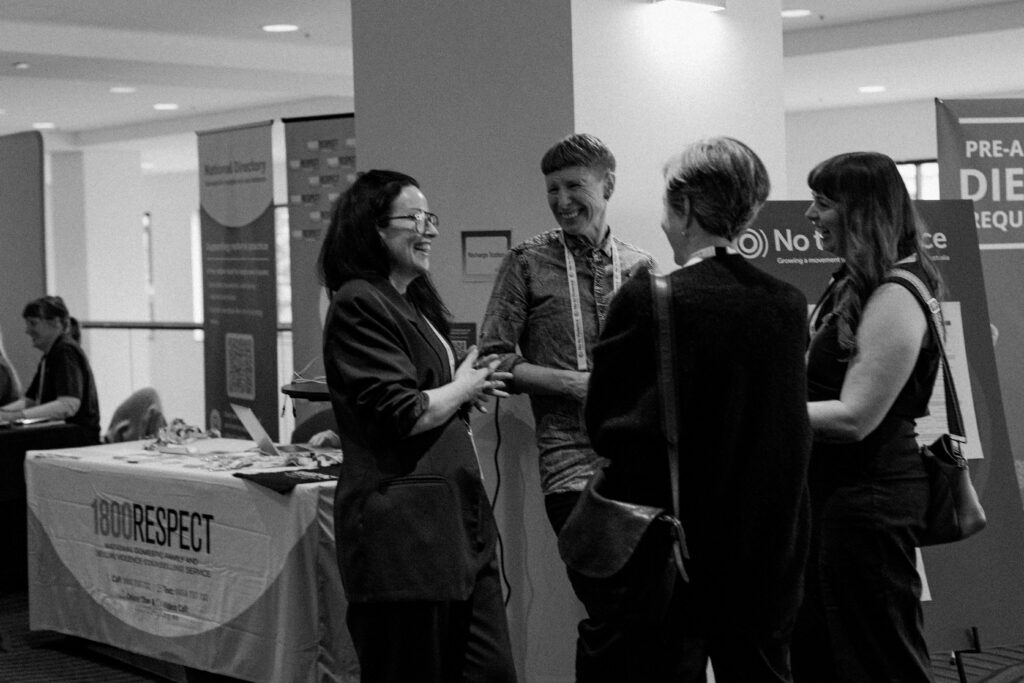
Photos by Cassie Sullivan / IG: @cassiesullivanphotography
Event website: events.ntv.org.au